

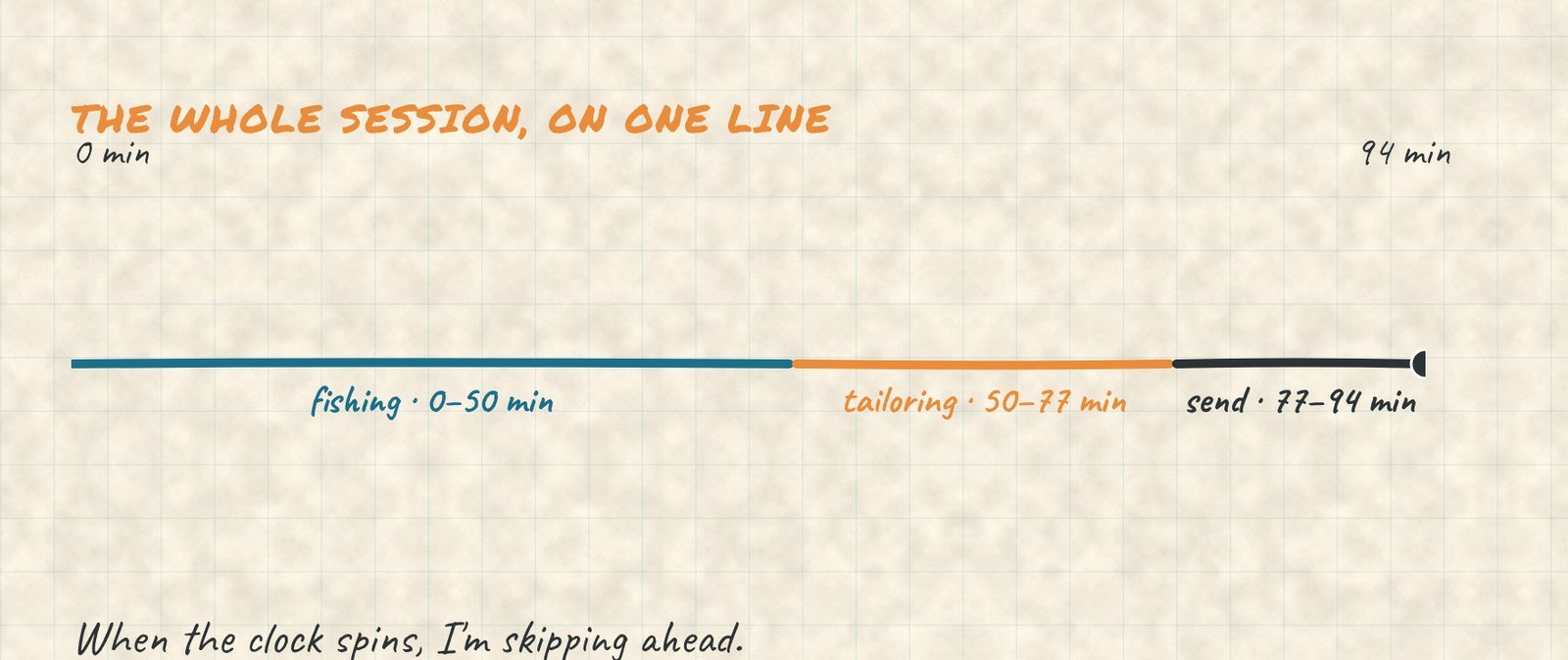
Short answer: A good job search session has a start, an end, and something sent. This one ran 94 minutes: about 50 searching and finding better search words, 25 tailoring one job at a time with AI, and 15 sending and tracking. It ended with two tailored applications.
Ninety-four minutes. Two applications. And I'm going to show you all of it, honestly.
Most job search advice shows you the clean version. Ten tips, a template, a before-and-after. What it doesn't show you is the actual block of time: the tabs, the dead ends, the posting that looked perfect and wasn't. So I sat down and ran a search, start to finish, and recorded the whole thing.
The search was for Ryan. Ryan is a composite job seeker, built from the patterns I see in coaching every day. He graduated with a degree in sociology, he's working shifts at a gear store, and he's been searching for weeks while the job boards keep handing him the wrong jobs.
I'm leaving the mess in on purpose. The dead ends, the tabs, the AI getting it wrong. Because if you only ever see the clean version, you start thinking the mess means you're doing it wrong. You're not. This is the job.
Before you search: write down what counts
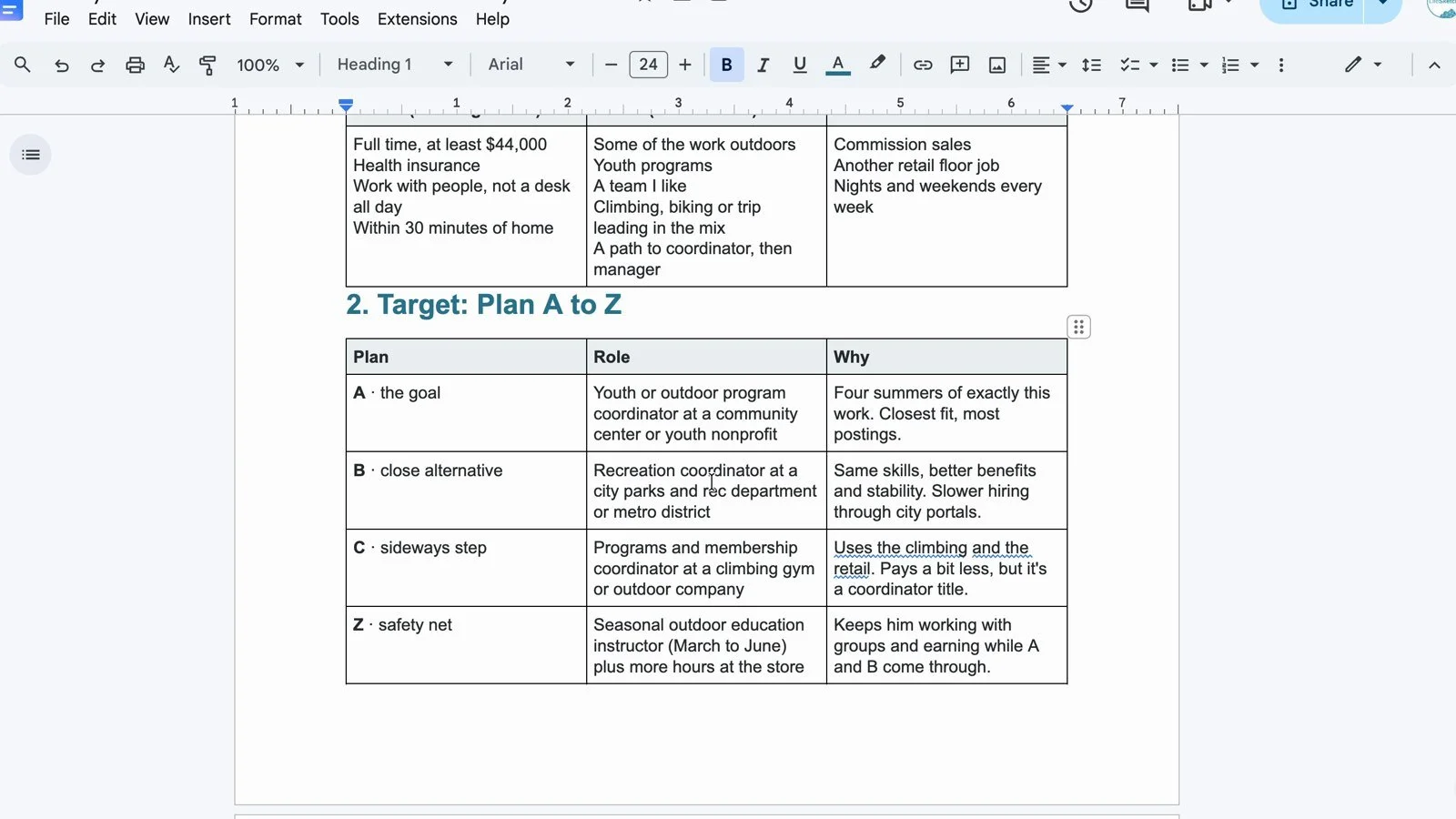
Before we searched anything, we opened Ryan's criteria. His must-haves: at least $44,000, full time, a commute he can live with. His wants: outdoors, and working with youth.
Then the plan, A to Z. Plan A is outdoor recreation. Plan B is youth programs. They overlap a lot (camps, outdoor ed, trips with kids), but they're different searches, and they turn up different jobs.
Everything after this gets measured against that page. That's what lets you move fast later without agonizing over every posting. Not sure yet what goes on yours? Find Your Path is a free tool that takes about 12 minutes and leaves you with a target you can actually search for.
Part 1: Finding the right words (about 50 minutes)
Sort, don't read
Last seven days only. Nothing he's already seen. And we move fast. Part-time, after school, golf course: skip, skip, skip. I'm not reading jobs yet. I'm sorting them. His criteria make the decisions, so he doesn't have to.
Read one paragraph down
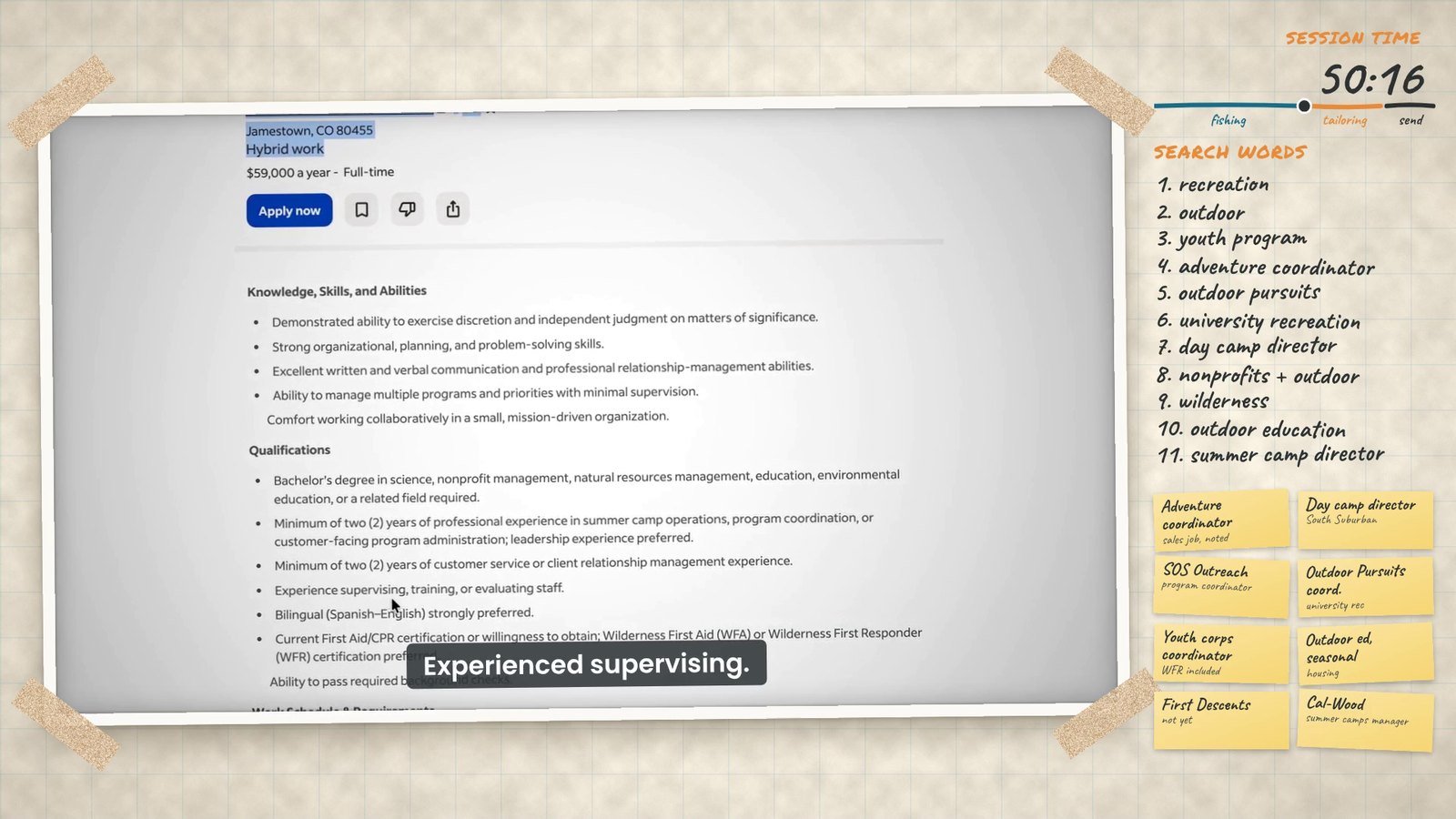
Then a title that sounds perfect. Adventure coordinator. Right pay, right industry. Then you read past the title, and it says they're looking for someone "to join our sales team." Same kind of title as the activity specialist role two postings later, and a totally different job.

I saved it to the tracker anyway, with a note. That way his brain doesn't have to remember it.
A closed job is still a clue
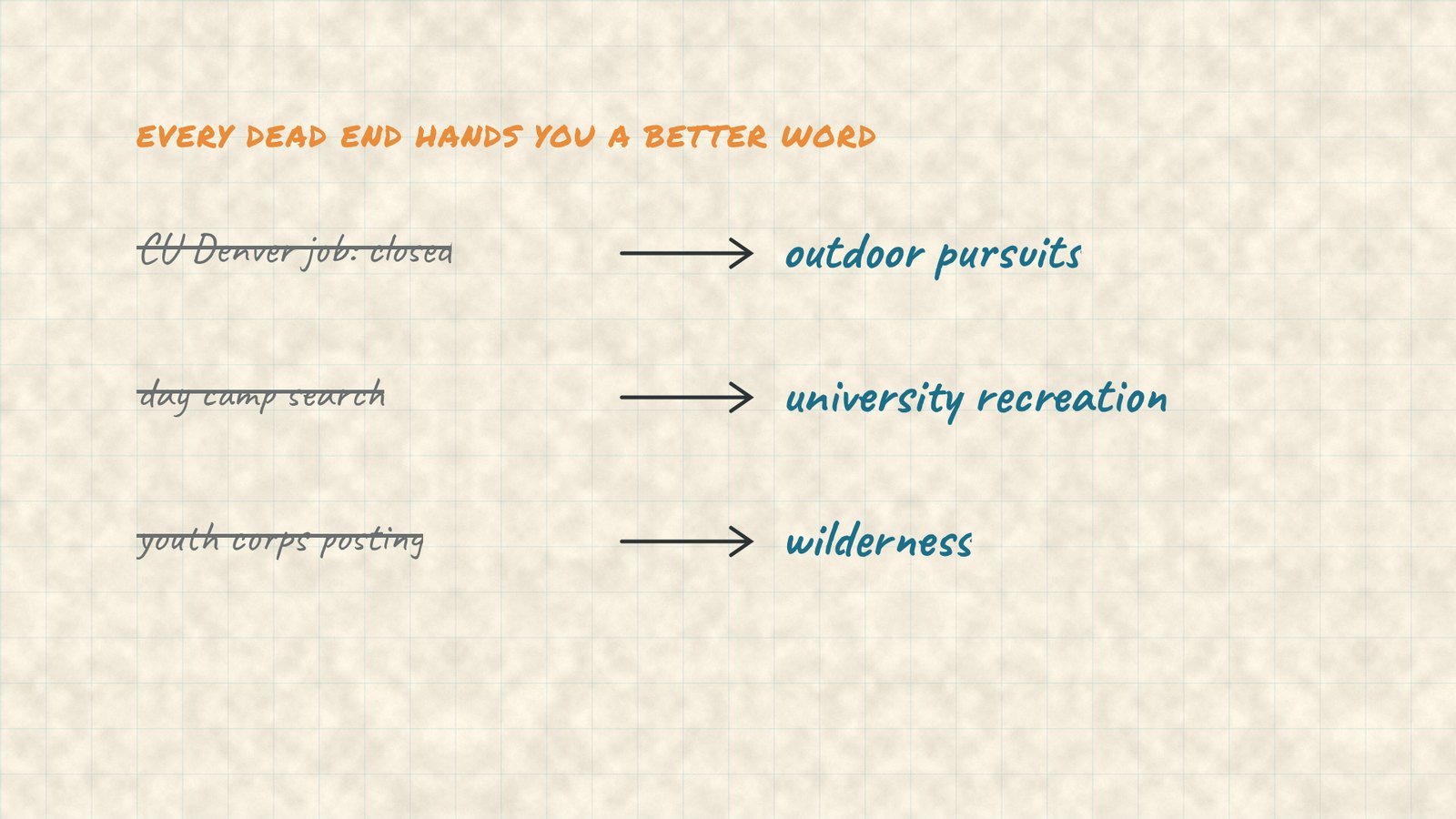
Ten minutes in, we found the one he really wanted: Outdoor Pursuits at CU Denver. A climbing wall, a bike shop, trips. Already closed.
But it handed us two words he never would have typed on his own: "outdoor pursuits." We searched it, and it opened up university recreation programs he didn't know existed. That's how the rest of the block went. Every dead end handed him a better word.
The part nobody shows you
Twenty minutes of rabbit holes. University sites. Dead links. Too many tabs. It feels like wasted time. It isn't. Every page that doesn't work teaches you what to search next.
A few habits that kept it from turning into a mess:
Save the full posting before it closes. Postings disappear, and you'll want that description when you tailor.
Look at jobs you don't qualify for yet. That's where you see what the next step is going to ask for.
Read the minimum qualifications first. That section is the make-or-break.
By the end of Part 1, Ryan had 11 new search words and 8 jobs worth keeping: a day camp director role, a youth corps coordinator job that includes the Wilderness First Responder training he's always wanted, a seasonal outdoor ed job with housing, and a summer camp manager role at Cal-Wood that checked every box.
Part 2: Tailoring, one job at a time (about 25 minutes)
Now, and only now, we stop searching and start tailoring.
Build a composite
Every posting he saved goes into one AI prompt. Not to write his resume. To tell us what these employers keep asking for: the top keywords and qualifications, in order. (Spelling optional. Notice I don't need to spell correctly at all.)
That gives you a composite: every job he wants, stacked into one. Now Ryan isn't guessing what they want. He has a checklist.
Hold the resume up against it
CPR and First Aid? He has it, so it goes up top. They say "supervised." He wrote "led." He did that; he just called it something else. So we use their word.
Same guy, said like it matters
Then the top of his resume. Same experience, rewritten in the employer's language:

See how powerful it is when it's real and it's directed? He didn't make anything up. Not one thing on there is new.
One job at a time
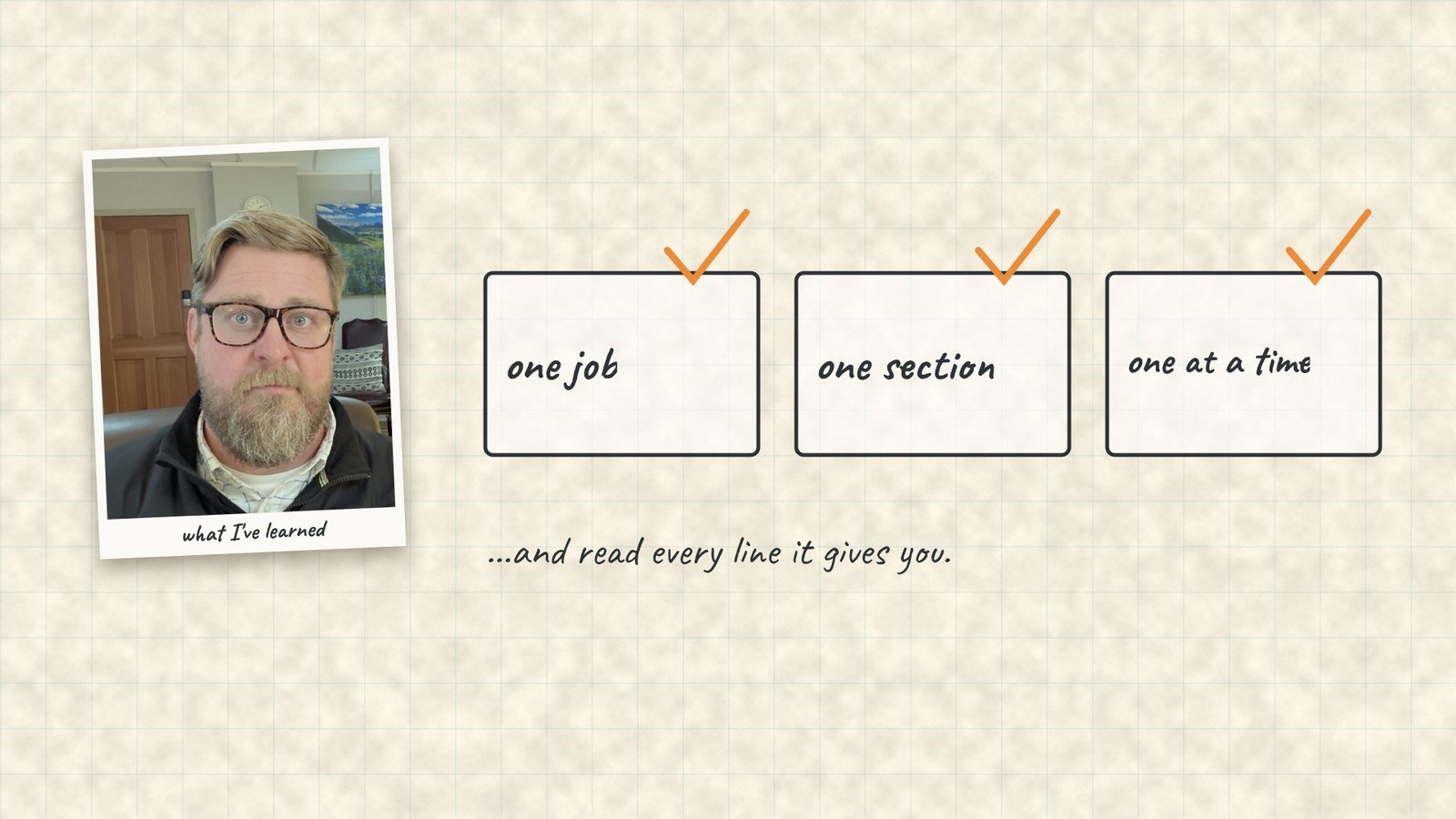
Here's what I've learned using AI for this. Ask for everything at once and you get mush. One job. One section. At a time. And you read every line it gives you. If you didn't do it, it doesn't go on your resume.
(I really wanted it on one page. It did not fit. So we let that go and made two clean pages instead.)
Then the second application, for SOS Outreach. Same summers. Same guy. Aimed at a different organization. The changes are subtle, and that's the point.
Part 3: Send it, and track it (about 15 minutes)
Apply on the employer's own site whenever you can, not through the job board.
Start the cover letter from the same template every time. The AI still mixed up which job it was writing for, which is why you check its work. The part it can't write for you is why this place. For SOS, that meant reading their mission until Ryan's line wrote itself: "your belief that belonging starts on the mountain."
Save two PDFs with names a hiring manager can find.
Log it in the tracker: applied, the date, and a follow-up date.
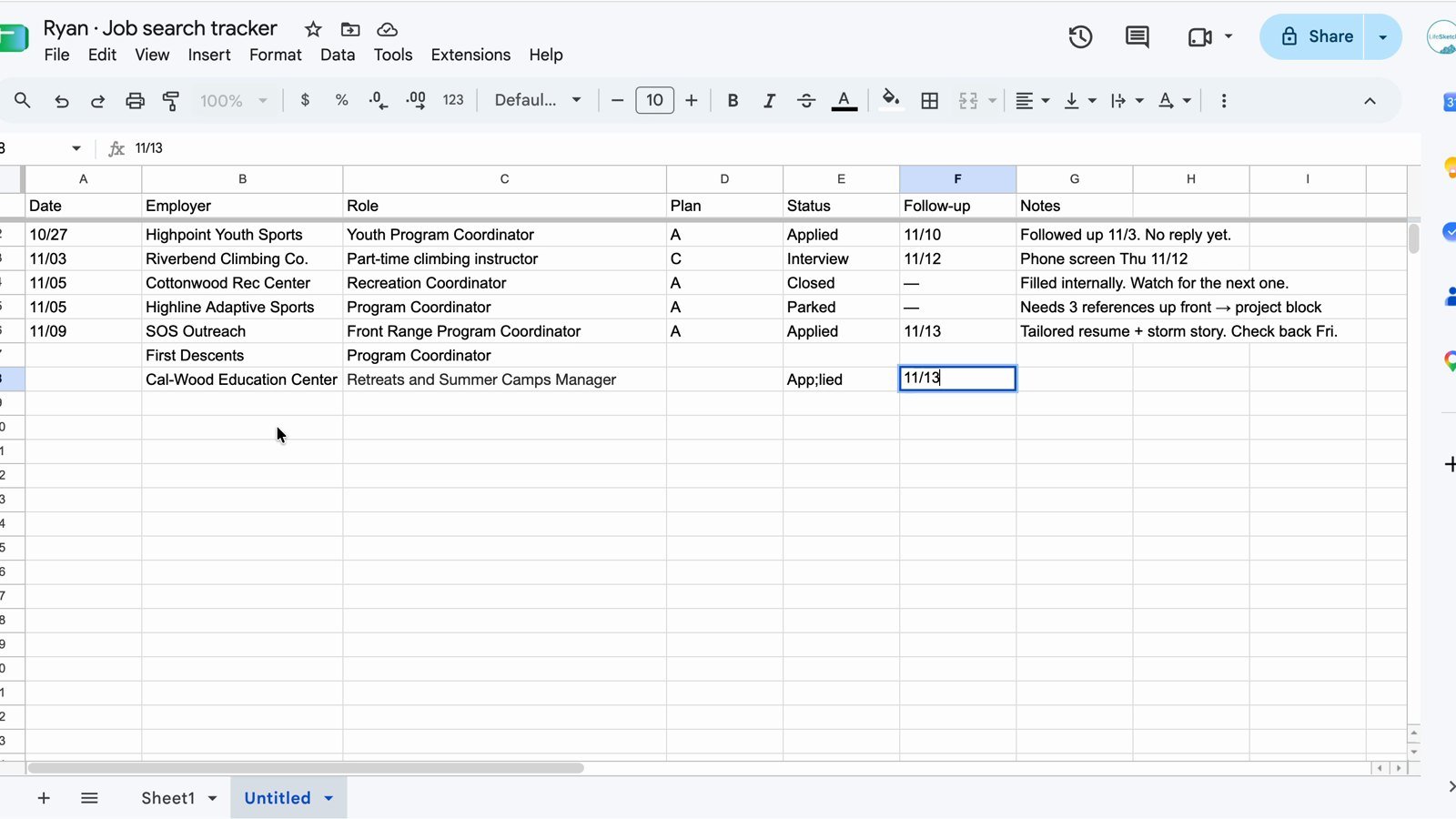
Then the laptop closes.
Ninety-four minutes, two applications
Ninety-four minutes. Eleven new search words. Eight jobs worth keeping. Two applications. That's what a good block looks like. It narrows.
It's not fast. It's not pretty. But it works. And next week, there's another block.
Three habits to steal

Sort fast. Don't read every job. Your criteria decide.
Follow the words. Every dead end hands you a better one.
Tailor one job at a time. Then check every line.
If you have ADHD
You saw it in the video: too many tabs, a detour or two. That's my ADD in real life. What kept the block on track wasn't willpower. It was the structure around it: the criteria page that made decisions for me, a tracker so nothing had to live in my head, and a block with a start and an end.
Common questions
How long should a job search session be?
Long enough to finish something. This one ran 94 minutes and ended with two applications sent and tracked. In Ryan's regular week, his search blocks are an hour and a half, three mornings a week, each with a clear start and stop.
How many applications should I send a week?
Fewer than you think, done better. Two tailored applications that sound like you beat ten generic ones.
Is it OK to use AI to tailor a resume?
Yes, as a tool for finding the employer's language, one job and one section at a time. You check every line, and nothing goes on the page that you didn't actually do.
Watch the whole week
This block is one piece of a full week. If you want to see how it fits around work, family and everything else, the full video shows three different job seekers' weeks. For why most searches stall in the first place, read Why Your Job Search Isn't Working in 2026.
And if you'd rather not do this alone, book a free call.
Scott Treas, MA, is an ADHD career coach and the founder of LifeSketch in Littleton, Colorado. With a background in counseling, he helps adults with ADHD figure out what they want and build a job search they can actually stick to.