

You send applications and hear nothing. Or you don't send them at all.
Either way, you can't stick to it. The day-to-day falls apart, and the longer it goes, the harder it gets to keep going. You start wondering if something is wrong with you.
It isn't a motivation problem. The silence makes it harder to start. Not starting means more silence. Push harder on the wrong thing and it just gets worse.
I've had a number of clients tell me they're almost sort of pretending to job search. They're doing just enough to keep the shame or guilt at bay, or to keep others off their back, but they're not fully committed to actually doing it. Then there are the people on the other side: doom-scrolling and mass applying, usually on Indeed or LinkedIn, one-click, one resume for everything. They're getting ghosted and stacking up rejection. You can only do either one for so long. Confidence and motivation start to crumble, and both paths end up in the same place.
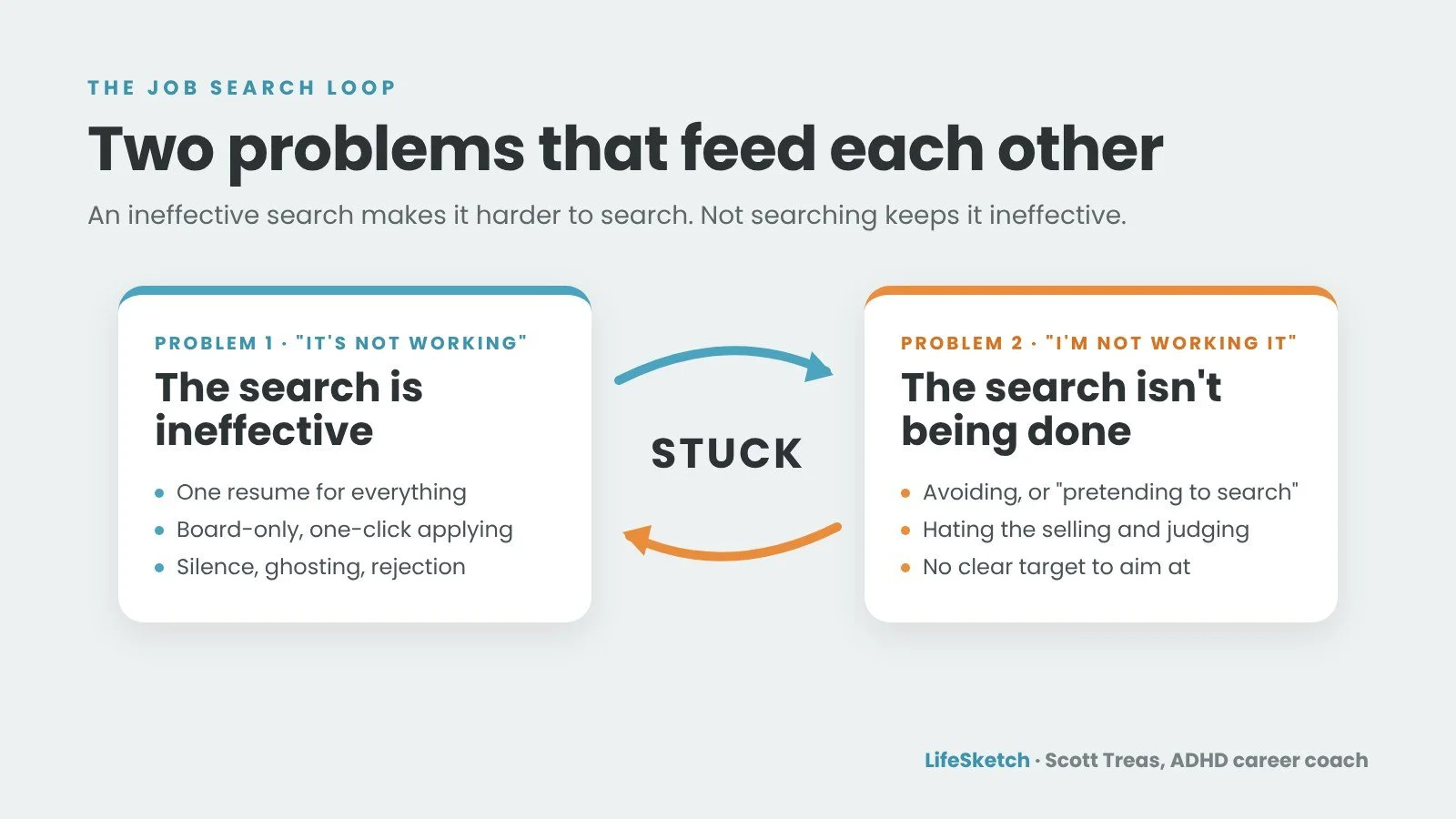
The short answer: If you can't find a job, there are usually two problems at work, and they feed each other. Either the search is ineffective (one resume, board-only applying, little tailoring), or the search isn't really being done (avoidance, dread, no clear target). The silence from an ineffective search makes it harder to start, and not starting keeps the search ineffective. The way out isn't more applications or more willpower. It's a week you can actually stick to, a search that uses more than one channel, and three numbers you track so you know what to fix.
Why can't I find a job? The two problems
Problem 1: The search is ineffective
Most people are running a scattered, board-only search. One resume. Minimal tailoring. A lot of people customize the cover letter and leave the resume alone, which is backwards. No one is going to read your cover letter if your resume doesn't already show you fit. And good tailoring starts with being targeted.
When we look at the numbers, some people are at four interviews out of a hundred applications. Others have sent five to ten applications in four months. Either way, there's not much data, and even less feedback.
Online applications (what I call Fishing) are the most visible channel and one of the lowest-return. In my experience, an untailored online application gets a response somewhere between under 1% and maybe 4% of the time, and that's when it's going well. Meanwhile, when I ask clients how they got their past jobs, most found the majority of them through someone they knew. The research points the same way. In a Federal Reserve Bank of New York study of one large company's hiring, referred candidates were only 6% of applicants but 29% of hires.
Effort does matter. A large review of job search research found that searching harder gets you more interviews and offers. But sheer volume didn't predict landing a better job. How well people ran their search predicted both (van Hooft et al., 2021). Treating the search as one activity, submit and wait, keeps the silence going.
Problem 2: The search isn't being done
Some people burned out after trying. Some are apprehensive about starting at all. A lot of people just hate the process: the selling, the performing, being judged. It leaves a really icky feeling. Many people would love to work and absolutely hate the search. Others are protecting themselves. Not applying means never facing the interview they dread. Some are comfortable enough with the status quo, even if it's not great, that challenging it feels riskier than staying put. Better the devil you know.
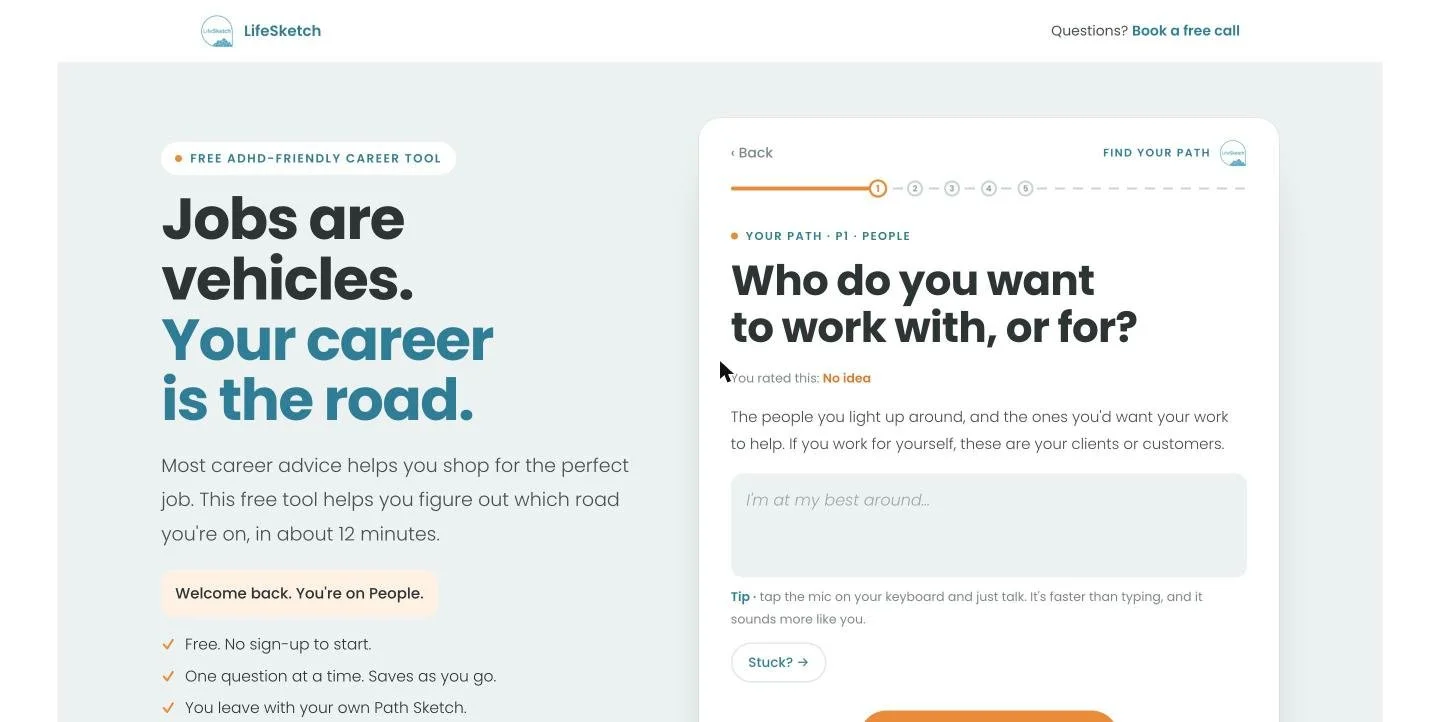
And some don't have a clear picture yet of what they want, what they have to offer, or where they fit, so there's nothing to aim at. If that's you, start there before you apply anywhere. Find Your Path is a free tool that takes about 12 minutes and leaves you with a target you can actually search for.
How do people realize they're in this group? Usually when they actually look at it and talk about it. I don't tell people they're pretending. They tell me: "I'm not actually committed to this." From my counseling background and my coaching, I'd put it this way: if you're not being honest with me, it's really that you're not being honest with yourself.
There's also resistance to anything that feels like networking or direct outreach. "I don't have a network." "I hate asking for favors." Shame. Fear that it will feel presumptuous or get rejected. So the default stays the low-risk online grind, even when most of their past jobs came through someone they knew. Online feels safer. You don't have to put yourself out there, and you don't have to face that kind of rejection.
How the two problems feed each other
An ineffective search produces silence and rejection, which makes it harder to keep going. Not going keeps the search ineffective. That's the loop: it's not working, so I'm not working it. Months of it can turn into learned helplessness. You stop believing anything will work, so you do even less of what might.
What actually fixes a stuck job search?
The fix isn't more applications or more willpower. It's a week you can actually stick to, built around the life you already have, plus a search that uses more than one channel.
People tell themselves they'll treat the job search like a full-time job. Honestly, I don't know what anyone would do for 40 hours a week inside a job search. So we start somewhere else: the non-negotiables. Work shifts, kid pickup, the things that don't move. Then we put in the rest of life: sleep, exercise, friends, the stuff that keeps you functional. Only after that do we fill the gaps with search work.
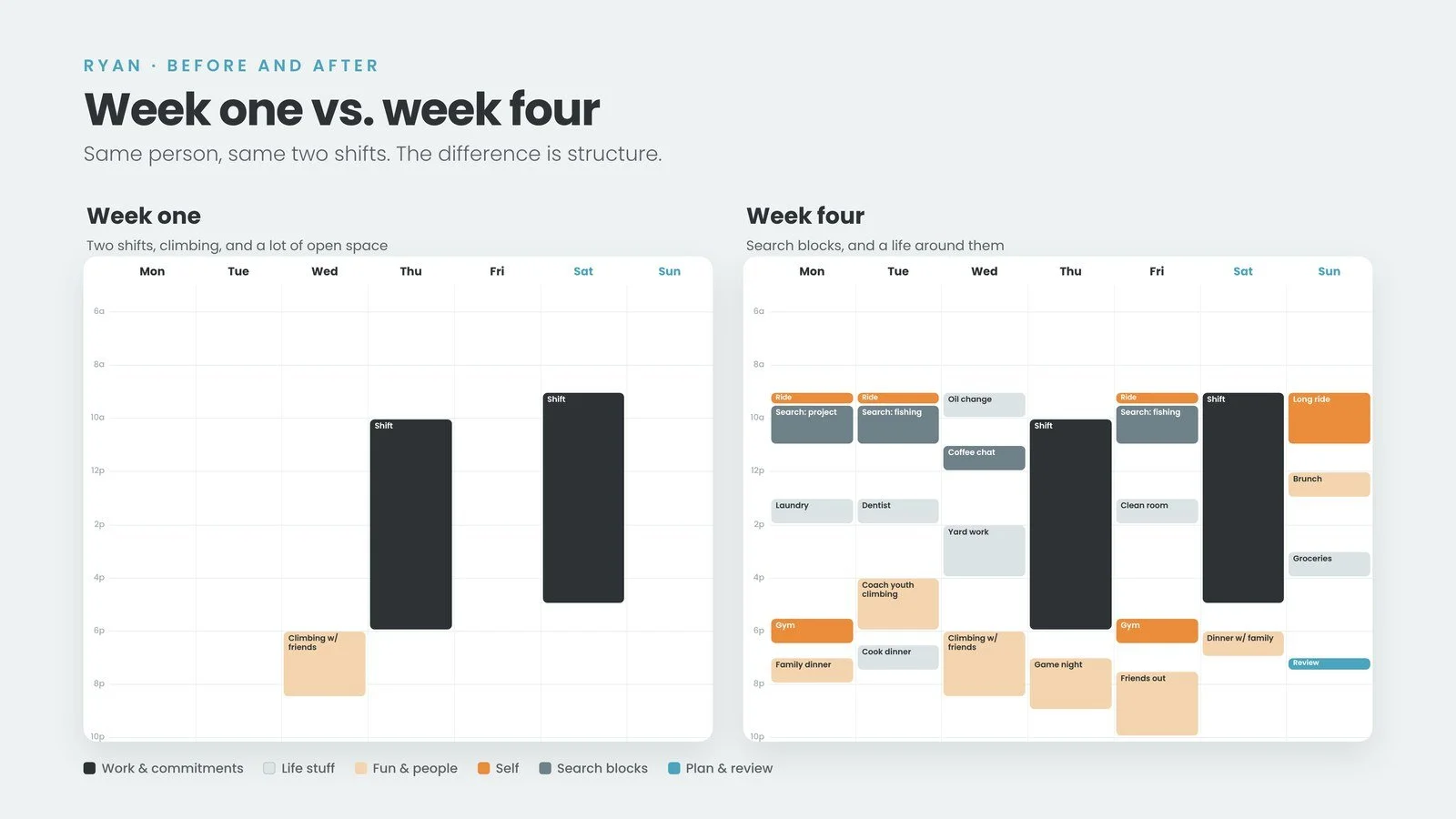
And "job search" on the calendar doesn't just mean applying. It might be reverse-engineering three to five job descriptions. It might be building your tailored niche resume, the one that's about 80% ready before you adjust it for a specific posting. It might be a prospect list of companies hiring in your space, a walk to clear your head, or a short training to get the language back when you've been out of it for a while and feel rusty. Some weeks the work is applications. Some weeks it's research. Some weeks an interview lands and everything shifts.
We plan the season (what are you trying to do across this whole search?) and then we plan the week (who are you this week?). The week changes, which is why we come back to it every week instead of setting it once and forgetting it. The search is a season. It ends when you say yes to a role and move into onboarding. But you'll go through this again. The skill is learning how to run one.
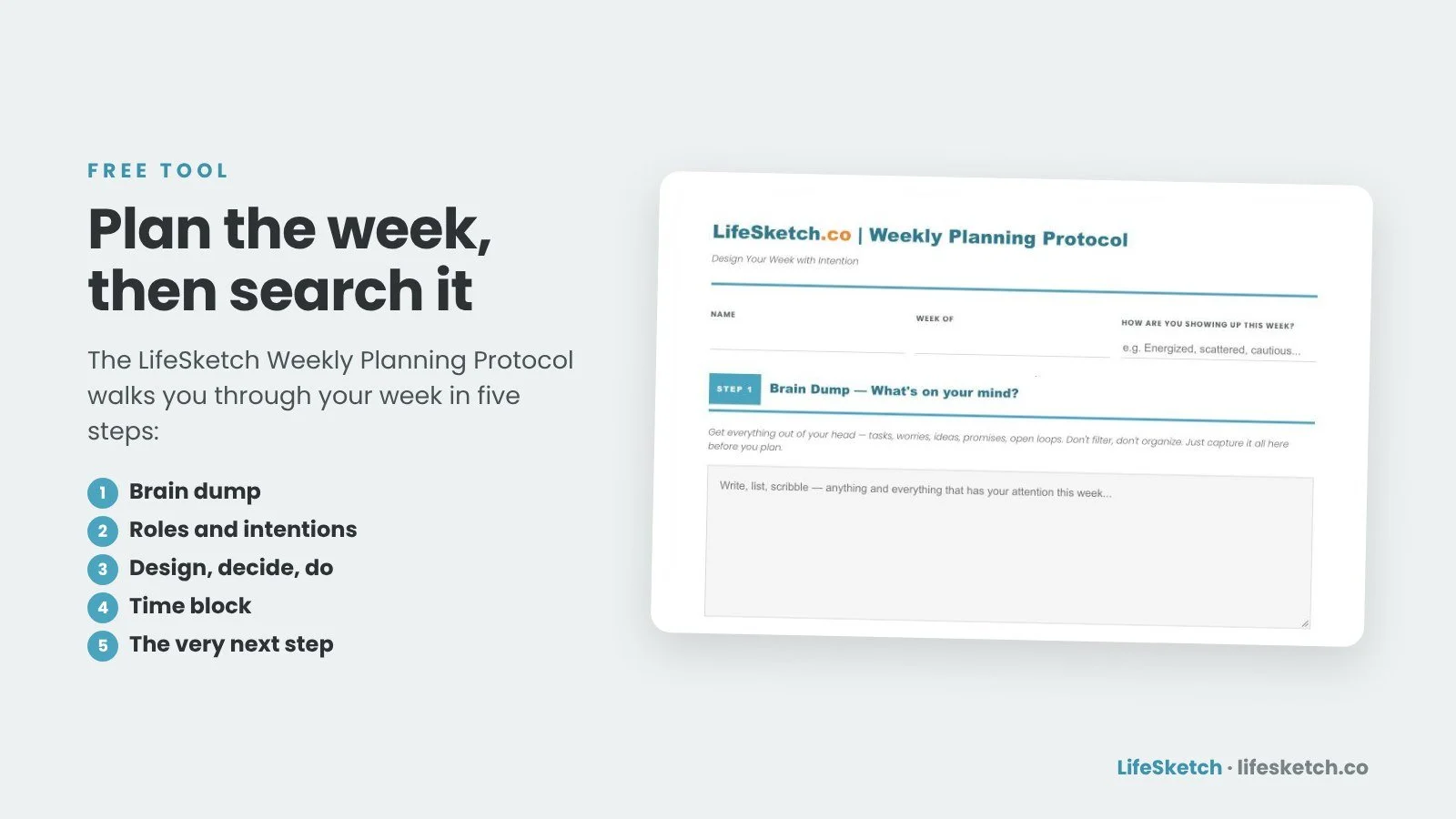
If you want a simple way to plan the week, use the free LifeSketch Weekly Planning Protocol.
Why start with empathy for the employer?
The other piece is treating your career like a business and starting with empathy. Work is relational. You're not applying to a posting. You're applying to work with people who have a business or organization to run. They aren't hiring an accountant. They're hiring a person who can do the accounting and help them understand their numbers.
If a posting has 250 applications, the hiring manager is buried. If it takes about three minutes to fully read one resume, 250 of them is more than twelve hours of reading before anyone gets a call. So they skim. In Ladders' eye-tracking studies, recruiters spent about six to seven seconds on a first scan.
Your job isn't to shout louder. Think of the cocktail party effect: in a loud room, you still hear your own name. So call out theirs. Use the language from their posting. Show you fit in that first scan so they have a reason to read the rest. Then make sure there's real substance underneath, because if you move into later rounds, they will read it closely.
That's also why your resume doesn't need to be fancy. I was an art major for a while, and I'll still tell you: a resume isn't supposed to be interesting-looking. It's supposed to be useful. It's not about you. It's a marketing document, and your customer is the employer. A business that's obsessed with itself doesn't stay in business very long.
Being employer-centric also means knowing your market before you decide volume is the answer. I worked with someone in Washington who was interested in oil and gas, since some of those roles pay well without a college degree. When we searched, there were almost no drilling or field roles in his state. Most of the industry there was refining. The same search around Denver turned up 80 to 100 openings. Same person, same goal, completely different map. The numbers told us which problem we were actually solving.
What are Fishing, Hunting and Farming?
A full strategy uses three channels. Fishing is online applications, done with precision instead of volume. Hunting is pursuing employers directly: researching decision-makers, starting low-pressure conversations, asking for referrals, sometimes proposing a role that doesn't exist yet. Farming is attracting opportunities so people come to you through your network, your presence, or recruiters. Most people over-invest in the lowest-return channel and under-invest in the ones that more often lead to hires.
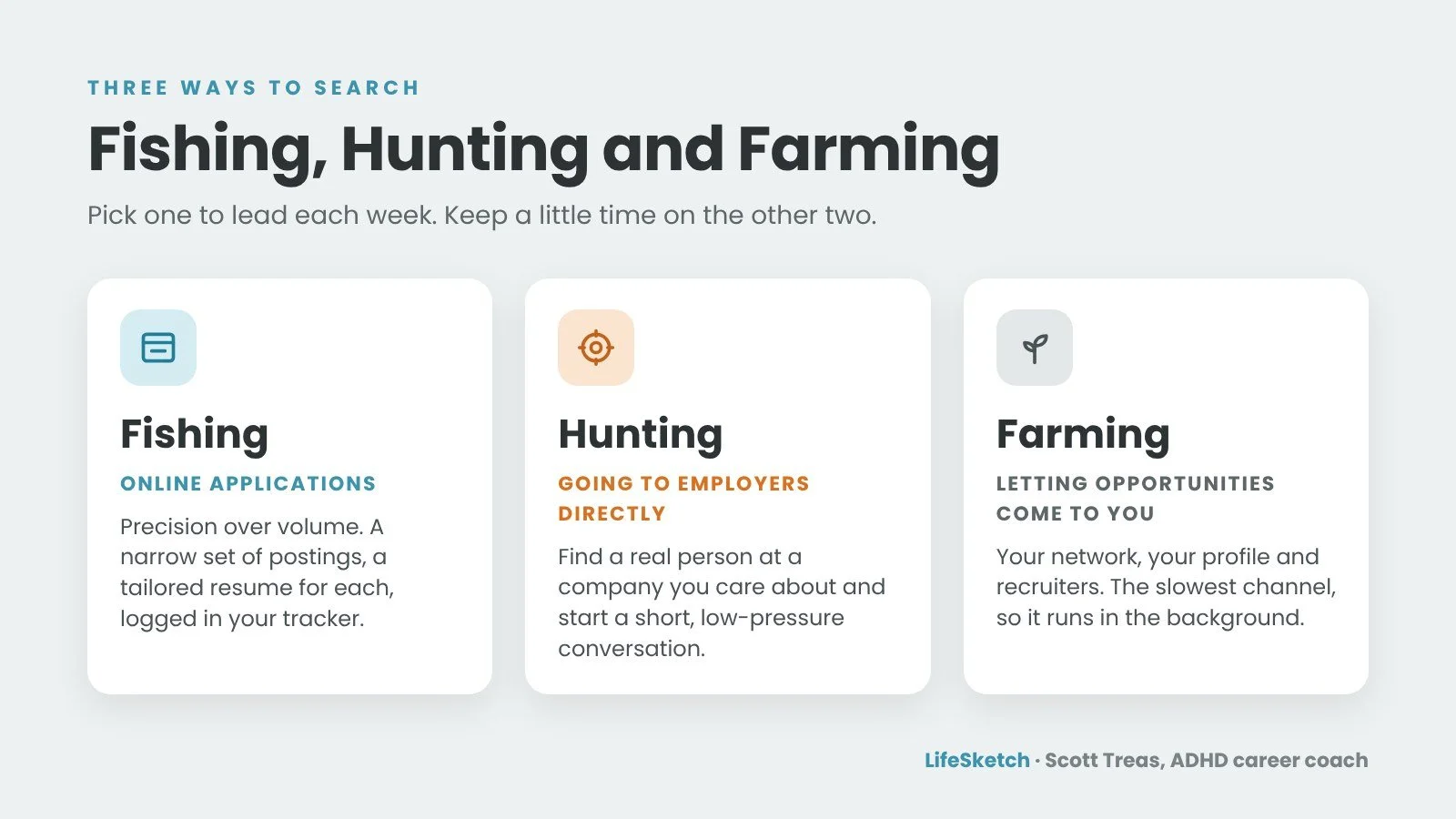
Here's how the three fit into a week that already has your real life in it. You don't run all three at full intensity every week. You pick a primary channel for the week based on where you are, then put a little time on the others so nothing goes completely cold.
Fishing weeks
For when you have a clear target and solid materials. Two or three blocks of 60 to 90 minutes. In each block you search a narrow set of postings, select the ones that actually fit, tailor your resume for that specific role, submit, and log it. You stop at the planned number. The rest of the week has one short Farming touch (a LinkedIn comment or a message to someone you already know) and one Hunting research step (find one decision-maker at a target company). Your tracker shows whether the applications are producing replies. If the ratio stays low after a few of these weeks, you shift.
Hunting weeks
For when the online market is thin or you've been applying without results. The main blocks are research and outreach: list 10 to 15 companies, rank them, find a real person, send a short message asking for a conversation, and log the follow-up date. One lighter Fishing block keeps the posted market in view. One Farming action (updating a profile section or reconnecting with a former colleague) plants a seed. These weeks feel riskier because they involve people, which is exactly why most people avoid them. The week structure keeps the risk contained. You do the planned outreach, then you stop.
Farming weeks
Lighter on outreach and heavier on visibility. You might spend a block updating your LinkedIn summary for one target role, posting or commenting on something relevant, or following up with a recruiter who already has your materials. The supporting work is a little targeted Fishing and one Hunting conversation if one is already scheduled. Farming is the slowest channel, so it rarely stands alone. It sits inside the other weeks so the long game keeps moving while you do the work that can pay off sooner.
The week still starts with your non-negotiables and your life. The search blocks go in the gaps. At the end of the week you look at your tracker: what did you do, what moved, what needs a follow-up next week. Then you decide which channel leads the next seven days. An interview lands and the whole plan shifts toward prep. A conversation produces a referral and Hunting becomes the focus. Nothing is set and forgotten. You come back every week because the season is still going and the map keeps changing.
How do I know what's wrong with my job search?
You can hold this up for yourself without a coach. Count three things:
How many relevant jobs are you actually seeing?
How many are you applying to?
How many interviews are you getting?
Those three numbers tell you which side of the loop you're on. Four interviews out of ten applications is a different problem than four out of a hundred. Five applications in four months is a different problem than two hundred.
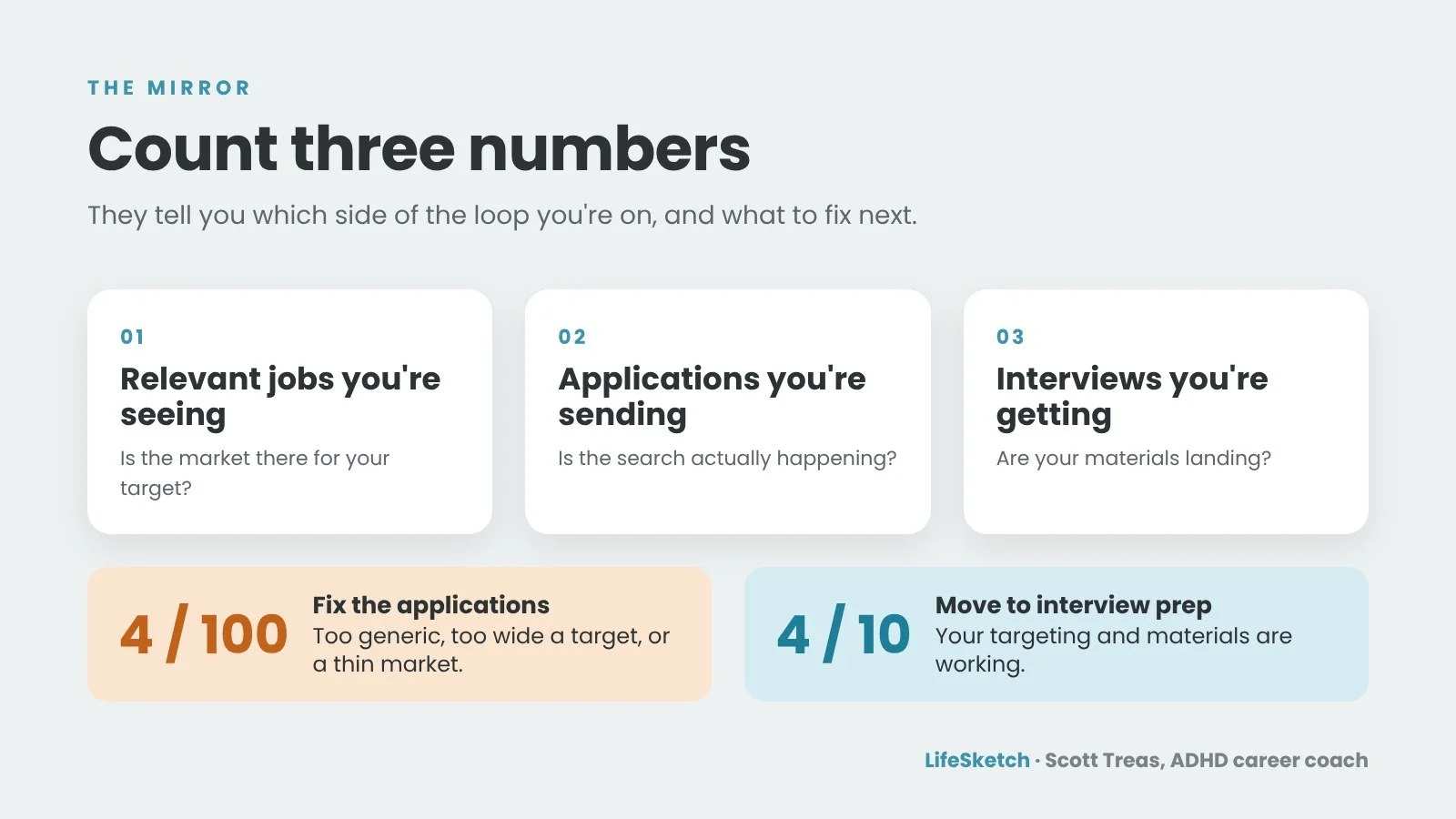
I recently worked with someone who had sent hundreds of applications in an earlier search. When he came back to it, he started tailoring and was getting about four interviews for every ten applications. I told him those are good numbers. So we stopped working on applications and moved to interview prep, because that's where his problem had moved.
Once you see the ratio, the next move gets clearer: more targeted applications, better materials, interview prep, a different target, or more energy toward conversations instead of more submissions. (For the most common mistakes behind a low ratio, see Why Your Job Search Isn't Working in 2026.)
Track it. Without a simple system you can't remember what you did, what's pending, or what needs a follow-up. The tracker is how the week stays honest. It also shows you when to stop doing more of what isn't working.
This isn't your last transition. You're going to do this again. The skill is owning your career the way you'd run a business: research the market, understand what the other side needs, measure what's working, and adjust. The platforms will keep changing. Indeed used to show how many results a search returned, which was how I taught people to size their market, and that's gone now. A few of my clients are already sending AI agents to search for them. What stays the same is that you keep looking at the real numbers and the real week, not the version that keeps the guilt down. Do you want the employer in charge of your future, or do you want to own it?
Watch the full breakdown. The video at the top of this post walks through a whole job search week, start to finish: the search blocks, the tools, and what to do when it goes sideways.
Want help building yours? Book a free 15-minute call. Not sure what you're aiming for yet? Start with Find Your Path.
Frequently asked questions
Is it normal to hate the job search even if I want to work?
Yes. A lot of people would love the work and hate the process. The search asks you to sell yourself, perform, and sit with silence or rejection. That feels very different from doing the job. Hating the search doesn't mean you aren't motivated to work. It usually means the process feels high-risk or low-reward right now. Naming that difference is the first step out of the loop.
How many applications should I send per week?
There's no universal number. Volume without a target, or without knowing how many relevant jobs exist, is mostly noise. Two or three well-tailored applications in a week can do more than twenty generic ones. Set a number you can sustain, then let your results tell you whether to change it.
How do I know if the problem is my applications or my interviews?
Look at your ratio of applications to interviews. If you're getting about four interviews from ten applications, your materials and targeting are working, and the next step is interview prep. If you're getting four from a hundred, the applications themselves usually aren't working: too generic, too wide a target, or a thin market for that role.
What if there aren't many jobs in my field or city?
Then volume isn't the constraint. It's a map problem. Before you decide you need to apply more, check how many roles actually match what you're looking for where you are. If they're scarce, your options are to widen your geography, adjust your target, or put more energy into Hunting and Farming so you aren't only waiting for postings.
Do I have to network if I hate it?
You don't have to love it, and you don't have to do it the way most people picture it. Hunting isn't asking for favors. It's starting a low-pressure conversation with someone at a company you already care about, or asking someone you know for an introduction. You can keep Fishing as one channel and still put a small, planned amount of Hunting into your week, so the higher-return path isn't at zero.
Should I tailor my resume or my cover letter?
Your resume, first. Most people customize the cover letter and leave the resume generic, which is backwards. The resume gets scanned first, often in just a few seconds, and if it doesn't already show you fit, the cover letter rarely gets read. Tailoring means using the language from the posting in your summary and experience. The cover letter can support that, but it can't replace it.
What does a realistic job search week look like if I work full-time or have kids?
It starts with the non-negotiables already on the calendar: work, pickup, the things that don't move. Then the rest of life goes in: sleep, exercise, people. The gaps that are left become your search blocks. Pick one primary channel for the week and put a little time on the other two. At the end of the week, look at what you actually did and decide what next week needs.
I stopped searching after a rejection. How do I start again?
First, acknowledge it. You put real hope into that one, and it hurt. Disappearing for a week afterward is really common. Coming back isn't starting over, though. It's just a new week: what are my roles, what are my intentions, where do things stand? Get curious about any feedback you got. Then go back to the structure that was working, and keep more than one application going so one "no" can't stop everything. If the low feeling isn't just about the search and it's showing up across your whole life, talk to a counselor or therapist. That isn't failure. It's the right tool.
I've done everything right for six weeks and nothing is happening. What now?
Ask three questions, in order. First, is the work actually good? Tailored, submitted, followed up on, at a pace you can keep. Get other eyes on it. Second, have you given it enough time? Different industries and levels hire on very different timelines, so ask people in your field what normal looks like. Third, if the work is good and the time has passed, change the play, not the effort: more Hunting, a different level of role, a nearby target, or a bridge like a part-time job, volunteering or a certification.
Sources
Brown, M., Setren, E., & Topa, G. (2013). Do informal referrals lead to better matches? Evidence from a firm's employee referral system. Federal Reserve Bank of New York Staff Report No. 568.
van Hooft, E. A. J., Kammeyer-Mueller, J. D., Wanberg, C. R., Kanfer, R., & Basbug, G. (2021). Job search and employment success: A quantitative review and future research agenda. Journal of Applied Psychology, 106(5), 674–713.
Ladders, Inc. (2018). Eye-Tracking Study (updating its 2012 study).
Scott Treas, MA, LPC, is an ADHD career coach and the founder of LifeSketch in Littleton, Colorado. With a background in counseling, he helps adults with ADHD figure out what they want and build a job search they can actually stick to.